01
Multi-OEM coverage as one practice
Server, storage, network, hyperconverged across 17+ OEM platforms under a single contract, single SLA, single after-action report. No finger-pointing at incident.

Why Choose WUC
Buyers compare us against the OEM and against traditional TPMs. We position differently: a single integrated operating practice with documented compliance posture, predictive failure modeling and fiscal-year-aligned terms that don't auto-renew. The OEM-alternative your CIO can defend at audit and your CFO can defend at FY review.
Four reasons
01
Server, storage, network, hyperconverged across 17+ OEM platforms under a single contract, single SLA, single after-action report. No finger-pointing at incident.
02
Operating practices documented to NIST SP 800-53 control families on request. Background-screened engineers, parts provenance with chain of custody, NIST 800-88 media sanitization.
03
OEM telemetry plus our lifecycle data drive component-level failure prediction. Replacement happens before incident, not after. Continuously, per fiscal-year refresh roadmap.
04
No auto-renewal. Termination-for-convenience and assignment provisions in plain language. Documented EoSL extension pattern with audit-accepted operating documentation.
Strategic differentiation
Six pressures every infrastructure leader carries. The OEM optimizes for refresh revenue; the traditional TPM optimizes for break-fix margin. WUC operates at the intersection neither serves cleanly.
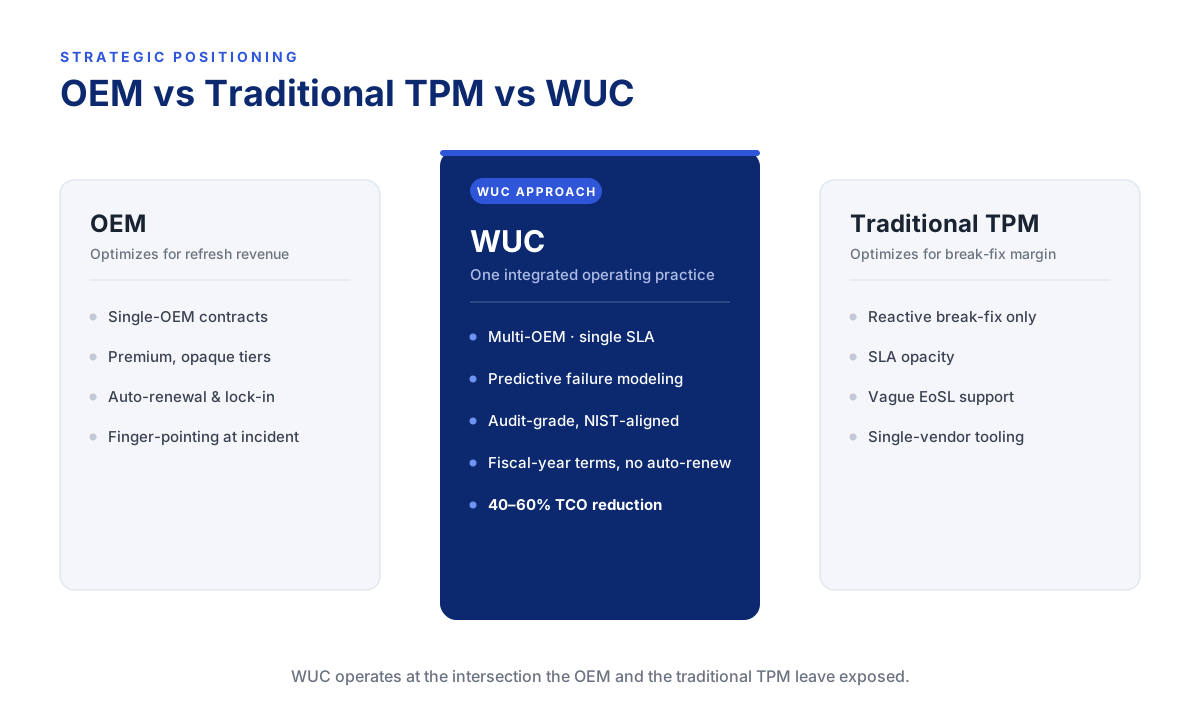
| Pressure | OEM | Traditional TPM | WUC Approach |
|---|---|---|---|
| Multi-vendor estate | Single-OEM contracts; finger-pointing at incident | Multi-vendor, but reactive only | Single multi-OEM contract, predictive intelligence, named practice lead per engagement |
| EoSL forces refresh | Refresh under capex; 12–18 month timeline | "We support EoSL" (vague) | Documented 7-year extension pattern with audit-accepted operating documentation |
| Cost pressure | Premium pricing, opaque coverage tiers | Discount on coverage, same SLA opacity | 30–50% TCO reduction with transparent decomposed model |
| Compliance scope | Generic "we comply"; control evidence at re-bid | Same; framework alignment vague | NIST 800-53 control families documented to operating-practice level on request |
| AI / predictive ask | Marketing buzzword | Marketing buzzword | OEM telemetry + lifecycle data → component-level failure prediction |
| Auto-renewal & vendor lock | Auto-renewal in standard MSA | Variable; usually present | No auto-renewal. Fiscal-year-aligned terms. Plain-language assignment provisions. |
Operating outcomes
Operating model
The maintenance contract is the surface. Underneath is a continuous lifecycle data model — assess, monitor, predict, maintain, optimize — that survives political and budget cycles.
Assess
Asset registry, framework alignment review, criticality tiering.
Monitor
OEM telemetry ingest, NOC operations, performance baseline.
Predict
Component-level failure prediction. AI on lifecycle data.
Maintain
Multi-OEM dispatch, parts provenance, after-action reporting.
Optimize
Quarterly review. Capex/opex modeling. Refresh roadmap update.
Late-funnel objections
No. The Magnuson-Moss Warranty Act (federal law) prohibits OEMs from voiding hardware warranty solely because a third party performed work, provided the third party didn't cause the issue. WUC engineers are background-screened, OEM-trained where applicable, and use OEM-traceable parts with documented chain of custody.
Yes. We hold parts inventory across server, storage, and network OEM lines for 7+ years past published EoSL on most platforms. Parts are OEM-traceable, anti-counterfeit screened, with documented chain of custody. EoSL extension is delivered under the same SLA tier as in-warranty equipment.
Typical observed reduction is 30–50% over a 3-year horizon, like-for-like at the SLA tier you actually need. The largest driver is the EoSL extension lever — agencies and enterprises avoid a refresh cycle the OEM had positioned as inevitable.
That's the core of the practice. One contract, one SLA, one engineer dispatch across 17+ OEM platforms. One after-action report. One point of accountability.
Standard tier-1 commit is 4-hour parts-and-engineer dispatch. Sub-options for 2-hour engineer commit on customer-defined criticality tiers. SLAs are written per-site, not as a national average.
Operating practices documented to NIST SP 800-53 Rev. 5 (control families AC, AU, CM, MA, PE, PS, SC), NIST SP 800-171 Rev. 3 for CUI-adjacent engagements, FISMA-aligned, FIPS 140-3 awareness, CJIS Security Policy alignment. Background-screened engineers. Specific control evidence is documented under NDA per agency requirement.
Engagement
Tell us the estate (servers, storage, network, OEM mix), your incumbent contract terms, and the constraint or deadline. We'll send a written proposal in one business day.